|
|||||||||||||||||||||||||||||||||||||||||||||||||||||||||||||












How to use the card deck for strategy planning
Games to play with the card deck
Robert Cantrell, the author, is a professional strategist and a client of Atchity Editorial/Entertainment International
Study Guide for Students of Sun Tzu
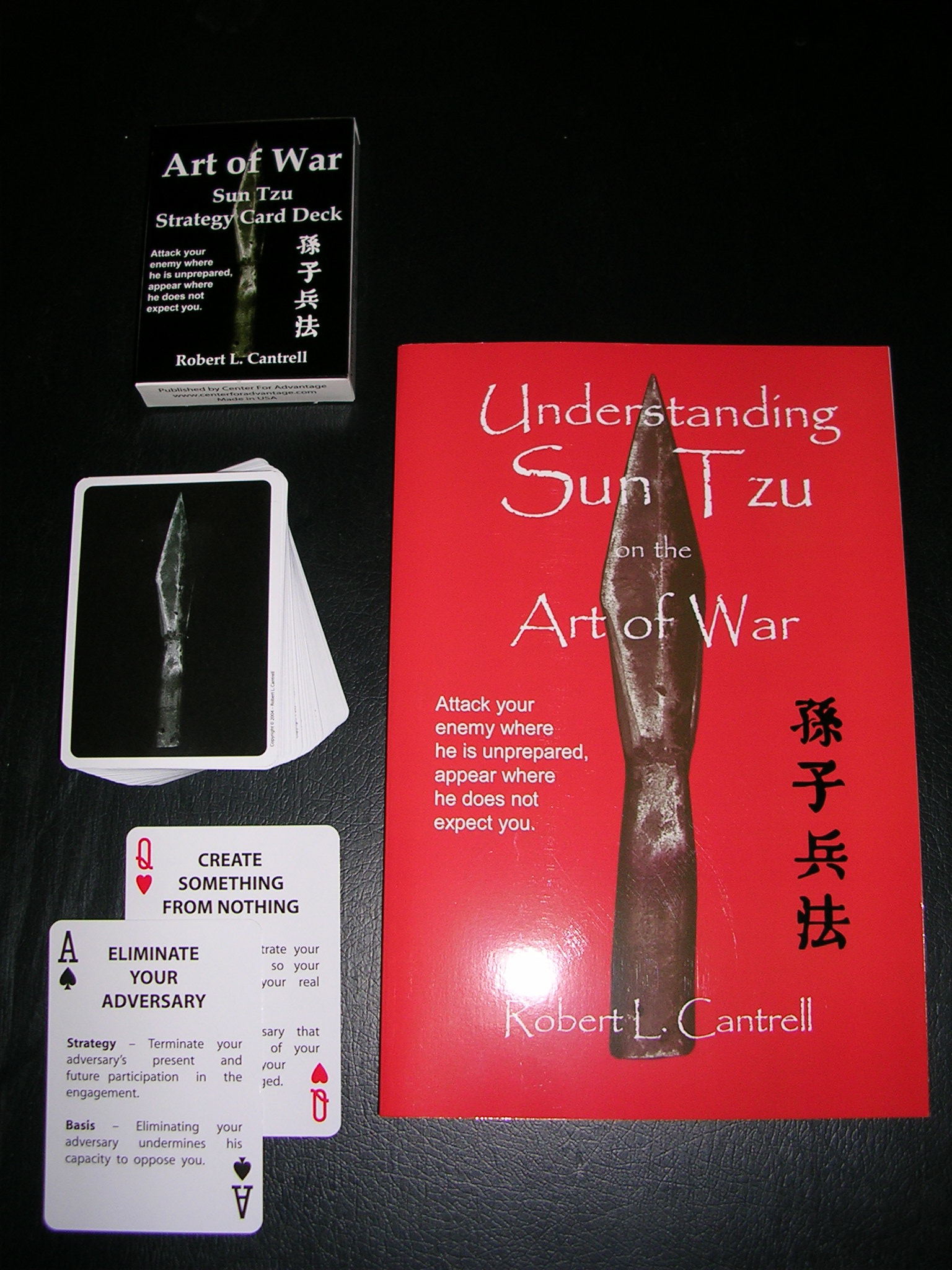
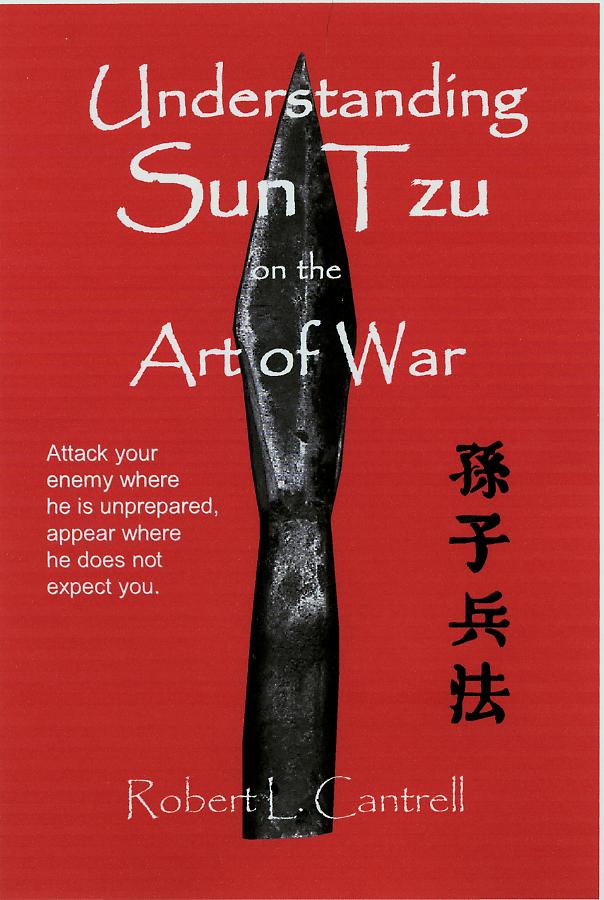
How to tie the Art of War Sun Tzu Strategy Card Deck with the companion book Understanding Sun Tzu on the Art of War
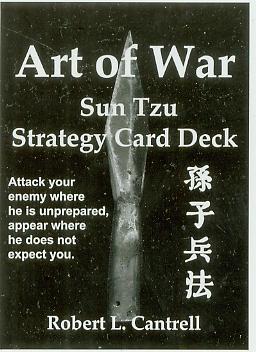
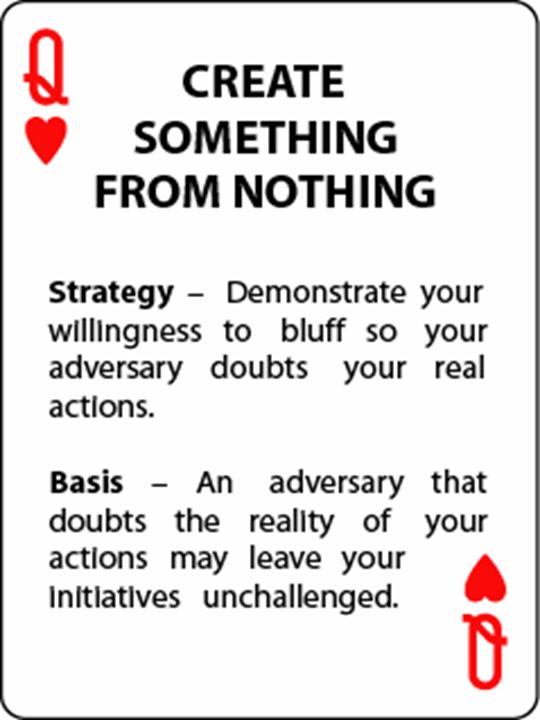
The 54 strategies found within the Art of War: Sun Tzu Strategy Card Deck are a mix of both historical and modern strategic concepts supported or derived from Sun Tzu on the Art of War. The 54 strategies, with a couple of exceptions, do not quote Sun Tzu directly, but instead represent useful derivatives of Sun Tzu’s ideas that you can immediately put to use.
The following list of correlations is for those people – students, instructors, or otherwise – who would like to further reflect on the ideas presented in the 54 strategies on the cards and match them up with specific Sun Tzu verses. The list below provides links for discussion and contemplation between Sun Tzu on the Art of War and the 54 strategies in the Art of War: Sun Tzu Strategy Card Deck. The numerical reference in the right side of the list refers to the numbering of verses used in both the original Lionel Giles translation and the edited Lionel Giles translation found within the book Understanding Sun Tzu on the Art of War. The cards and suites on the left side of the list refer to the strategies in the Art of War: Sun Tzu Strategy Card Deck.
The Art of War: Sun Tzu Strategy Card Deck and the book Understanding Sun Tzu on the Art of War work together to present a complete package for both students and trainers of Sun Tzu's ideas.
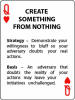
Card and Book Correlations
Includes Book to Cards and Cards to Book
1. Book to Cards
SUN TZU ON THE ART OF WAR
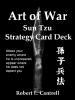
The following text links the Art of War: Sun Tzu Strategy Card Deck to the Art of War. Each playing card in the Art of War: Sun Tzu Strategy Card Deck represents a derivative of several ideas presented in Sun Tzu on the Art of War. The purpose of the cards is to offer ways to put Sun Tzu's ideas into actual practice. The following text of the Art of War links Sun Tzu's ideas to cards that commonly, but not exclusively, provide actions by which to carry those ideas out or take advantage of their effect
I. LAYING PLANS1. Sun Tzu said: The art of war is of vital importance to the State.Ace of Spades; Ace of Diamonds; Ace of Clubs; Ace of Hearts;2. It is a matter of life and death, a road either to safety or to ruin. Henceit is a subject of inquiry which can on no account be neglected.Ace of Spades; Ace of Diamonds; Ace of Clubs; Ace of Hearts;3. The art of war, then, is governed by five constant factors, to be takeninto account in one's deliberations, when seeking to determine theconditions obtaining in the field.4. These are: (1) The Moral Law; (2) Heaven; (3) Earth; (4)The Commander; (5) Method and discipline.5,6. The Moral Law causes the people to be in complete accord with their ruler,so that they will follow him regardless of their lives, undismayed by any danger.8. Earth comprises distances, great and small; danger and security; openground and narrow passes; the chances of life and death.9. The Commander stands for the virtues of wisdom, sincerely,benevolence, courage and strictness.10. By method and discipline are to be understood the marshaling of the armyin its proper subdivisions, the graduations of rank among the officers,the maintenance of roads by which supplies may reach the army, and thecontrol of military expenditure.11. These five heads should be familiar to every general: he who knows themwill be victorious; he who knows them not will fail.12. Therefore, in your deliberations, when seeking to determine the militaryconditions, let them be made the basis of a comparison, in this wise:--Jack of Clubs;13. (1) Which of the two sovereigns is imbued with the Moral law?(2) Which of the two generals has most ability?(3) With whom lie the advantages derived from Heavenand Earth?(4) On which side is discipline most rigorously enforced?(5) Which army is stronger?(6) On which side are officers and men more highly trained?(7) In which army is there the greater constancy both in reward andpunishment?Jack of Clubs;14. By means of these seven considerations I can forecast victoryor defeat.Jack of Clubs;15. The general that hearkens to my counsel and acts upon it, will conquer:let such a one be retained in command! The general that hearkens not to mycounsel nor acts upon it, will suffer defeat:--let such a one be dismissed!Ace of Spades; Ace of Clubs;16. While heading the profit of my counsel, avail yourself also of anyhelpful circumstances over and beyond the ordinary rules.All especially Ace of Spades; King of Spades; Jack of Spades;10 of Spades; 8 of Spades; 6 of Spades; 5 of Spades;4 of Spades; 2 of Spades; Queen of Diamonds; 2 of Diamonds;Ace of Clubs; King of Clubs; 9 of Clubs; 7 of Clubs;Jack of Hearts; 2 of Hearts;6 of Spades; 2 of Spades; 2 of Diamonds; 9 of Clubs;Jack of Hearts;18. All warfare is based on deception.10 of Diamonds; Queen of Hearts;19. Hence, when able to attack, we must seem unable; when using ourforces, we must seem inactive; when we are near, we must make the enemybelieve we are far away; when far away, we must make him believe weare near.10 of Diamonds; 6 of Clubs; 5 of Clubs; Queen of Hearts;20. Hold out baits to entice the enemy. Feign disorder, and crush him.6 of Diamonds;22. If your opponent is of choleric temper, seek to irritate him. Pretendto be weak, that he may grow arrogant.5 of Hearts;23. If he is taking his ease, give him no rest. If his forces are united, separatethem.9 of Spades; Ace of Diamonds;24. Attack him where he is unprepared, appear where you are not expected.Jack of Spades; 6 of Clubs;25. These military devices, leading to victory, must not be divulgedbeforehand.26. Now the general who wins a battle makes many calculations inhis temple ere the battle is fought. The general who loses a battlemakes but few calculations beforehand. Thus do manycalculations lead to victory, and few calculations to defeat: how muchmore no calculation at all! It is by attention to this point that I can foreseewho is likely to win or lose.1. Sun Tzu said: In the operations of war,where there are in the field a thousand swift chariots,as many heavy chariots, and a hundred thousandmail-clad soldiers, with provisions enough to carry thema thousand li, the expenditure at home and at the front,including entertainment of guests, small items such asglue and paint, and sums spent on chariots and armor,will reach the total of a thousand ounces of silver per day.Such is the cost of raising an army of 100,000 men.2. When you engage in actual fighting, if victoryis long in coming, then men's weapons will grow dull andtheir ardor will be damped. If you lay siege to a town,you will exhaust your strength.2 of Clubs;3. Again, if the campaign is protracted, the resourcesof the State will not be equal to the strain.2 of Clubs;4. Now, when your weapons are dulled, your ardor damped,your strength exhausted and your treasure spent,other chieftains will spring up to take advantageof your extremity. Then no man, however wise,will be able to avert the consequences that must ensue.2 of Clubs;5. Thus, though we have heard of stupid haste in war,cleverness has never been seen associated with long delays.6. There is no instance of a country having benefitedfrom prolonged warfare.Queen of Clubs; 2 of Clubs; 2 of Hearts;7. It is only one who is thoroughly acquaintedwith the evils of war that can thoroughly understandthe profitable way of carrying it on.8. The skillful soldier does not raise a second levy,neither are his supply-wagons loaded more than twice.9. Bring war material with you from home, but forageon the enemy. Thus the army will have food enoughfor its needs.10. Poverty of the State exchequer causes an armyto be maintained by contributions from a distance.Contributing to maintain an army at a distance causesthe people to be impoverished.11. On the other hand, the proximity of an army causesprices to go up; and high prices cause the people'ssubstance to be drained away.9 of Spades; Queen of Diamonds;12. When their substance is drained away, the peasantrywill be afflicted by heavy exactions.13,14. With this loss of substance and exhaustionof strength, the homes of the people will be stripped bare,and three-tenths of their income will be dissipated;while government expenses for broken chariots, worn-out horses,breast-plates and helmets, bows and arrows, spears and shields,protective mantles, draught-oxen and heavy wagons,will amount to four-tenths of its total revenue.Queen of Diamonds;15. Hence a wise general makes a point of foragingon the enemy. One cartload of the enemy's provisionsis equivalent to twenty of one's own, and likewisea single picul of his provender is equivalent to twentyfrom one's own store.16. Now in order to kill the enemy, our men mustbe roused to anger; that there may be advantage fromdefeating the enemy, they must have their rewards.Ace of Spades;17. Therefore in chariot fighting, when ten or more chariotshave been taken, those should be rewarded who took the first.Our own flags should be substituted for those of the enemy,and the chariots mingled and used in conjunction with ours.The captured soldiers should be kindly treated and kept.Ace of Clubs;18. This is called, using the conquered foe to augmentone's own strength.Ace of Clubs;19. In war, then, let your great object be victory,not lengthy campaigns.20. Thus it may be known that the leader of armiesis the arbiter of the people's fate, the man on whom itdepends whether the nation shall be in peace or in peril.1. Sun Tzu said: In the practical art of war, the bestthing of all is to take the enemy's country whole and intact;to shatter and destroy it is not so good. So, too, it isbetter to recapture an army entire than to destroy it,to capture a regiment, a detachment or a company entirethan to destroy them.Ace of Diamonds; Ace of Clubs;2. Hence to fight and conquer in all your battlesis not supreme excellence; supreme excellence consistsin breaking the enemy's resistance without fighting.4 of Spades; Ace of Clubs;3. Thus the highest form of generalship is tobalk the enemy's plans; the next best is to preventthe junction of the enemy's forces; the next inorder is to attack the enemy's army in the field;and the worst policy of all is to besiege walled cities.King of Spades; 8 of Spades;4. The rule is, not to besiege walled cities if itcan possibly be avoided. The preparation of mantlets,movable shelters, and various implements of war, will takeup three whole months; and the piling up of mounds overagainst the walls will take three months more.5. The general, unable to control his irritation,will launch his men to the assault like swarming ants,with the result that one-third of his men are slain,while the town still remains untaken. Such are the disastrouseffects of a siege.6. Therefore the skillful leader subdues the enemy'stroops without any fighting; he captures their citieswithout laying siege to them; he overthrows their kingdomwithout lengthy operations in the field.4 of Spades;7. With his forces intact he will dispute the masteryof the Empire, and thus, without losing a man, his triumphwill be complete. This is the method of attacking by stratagem.Ace of Spades; Ace of Diamonds ; Ace of Clubs; Ace of Hearts;8. It is the rule in war, if our forces are tento the enemy's one, to surround him; if five to one,to attack him; if twice as numerous, to divide our armyinto two.Ace of Spades; Ace of Diamonds; Ace of Clubs; Ace of Hearts;9. If equally matched, we can offer battle;if slightly inferior in numbers, we can avoid the enemy;if quite unequal in every way, we can flee from him.Ace of Spades; Ace of Diamonds; Ace of Clubs; Ace of Hearts;Plus 5 of Clubs; 2 of Hearts;10. Hence, though an obstinate fight may be madeby a small force, in the end it must be capturedby the larger force.Queen of Spades;11. Now the general is the bulwark of the State;if the bulwark is complete at all points; the State willbe strong; if the bulwark is defective, the State willbe weak.5 Spades;12. There are three ways in which a ruler can bringmisfortune upon his army:--All below 9 of Clubs; 8 of Clubs; 6 of Clubs; 3 of Clubs;13. (1) By commanding the army to advance or to retreat,being ignorant of the fact that it cannot obey.This is called hobbling the army.14. (2) By attempting to govern an army in thesame way as he administers a kingdom, being ignorantof the conditions which obtain in an army. This causesrestlessness in the soldier's minds.15. (3) By employing the officers of his armywithout discrimination, through ignorance of themilitary principle of adaptation to circumstances.This shakes the confidence of the soldiers.16. But when the army is restless and distrustful,trouble is sure to come from the other feudal princes.This is simply bringing anarchy into the army, and flingingvictory away.17. Thus we may know that there are five essentialsfor victory:All below Ace of Spades; Ace of Diamonds; Ace of Clubs;Ace of Hearts;(1) He will win who knows when to fight and whennot to fight.(2) He will win who knows how to handle both superiorand inferior forces.(3) He will win whose army is animated by the samespirit throughout all its ranks.(4) He will win who, prepared himself, waits to takethe enemy unprepared.10 of Clubs;(5) He will win who has military capacity and isnot interfered with by the sovereign.18. Hence the saying: If you know the enemyand know yourself, you need not fear the result of ahundred battles. If you know yourself but not the enemy,for every victory gained you will also suffer a defeat.If you know neither the enemy nor yourself, you willsuccumb in every battle.1. Sun Tzu said: The good fighters of old first putthemselves beyond the possibility of defeat, and thenwaited for an opportunity of defeating the enemy.6 of Spades; Ace of Hearts;2. To secure ourselves against defeat lies in ourown hands, but the opportunity of defeating the enemyis provided by the enemy himself.6 of Spades; 2 of Spades; 9 of Clubs; Jack of Hearts;3. Thus the good fighter is able to secure himself against defeat,but cannot make certain of defeating the enemy.Ace of Hearts;4. Hence the saying: One may know how to conquerwithout being able to do it.Ace of Hearts;5. Security against defeat implies defensive tactics;ability to defeat the enemy means taking the offensive.6. Standing on the defensive indicates insufficientstrength; attacking, a superabundance of strength.7. The general who is skilled in defense hides in themost secret recesses of the earth; he who is skilled inattack flashes forth from the topmost heights of heaven.Thus on the one hand we have ability to protect ourselves;on the other, a victory that is complete.8. To see victory only when it is within the kenof the common herd is not the acme of excellence.9. Neither is it the acme of excellence if you fightand conquer and the whole Empire says, "Well done!"10. To lift an autumn hair is no sign of great strength;to see the sun and moon is no sign of sharp sight;to hear the noise of thunder is no sign of a quick ear.11. What the ancients called a clever fighter isone who not only wins, but excels in winning with ease.Ace of Spades; King of Spades; Queen of Spades;8 of Diamonds;12. Hence his victories bring him neither reputationfor wisdom nor credit for courage.13. He wins his battles by making no mistakes.Making no mistakes is what establishes the certaintyof victory, for it means conquering an enemy that isalready defeated.King of Spades; Queen of Spades; 7 of Clubs;14. Hence the skillful fighter puts himself intoa position which makes defeat impossible, and doesnot miss the moment for defeating the enemy.Ace of Spades; Ace of Diamonds; Ace of Clubs;Ace of Hearts;15. Thus it is that in war the victorious strategistonly seeks battle after the victory has been won,whereas he who is destined to defeat first fightsand afterwards looks for victory.All16. The consummate leader cultivates the moral law,and strictly adheres to method and discipline; thus it isin his power to control success.17. In respect of military method, we have,firstly, Measurement; secondly, Estimation of quantity;thirdly, Calculation; fourthly, Balancing of chances;fifthly, Victory.18. Measurement owes its existence to Earth;Estimation of quantity to Measurement; Calculation toEstimation of quantity; Balancing of chances to Calculation;and Victory to Balancing of chances.19. A victorious army opposed to a routed one, is asa pound's weight placed in the scale against a single grain.Queen of Spades;20. The onrush of a conquering force is like the burstingof pent-up waters into a chasm a thousand fathoms deep.Queen of Spades;V. ENERGY1. Sun Tzu said: The control of a large forceis the same principle as the control of a few men:it is merely a question of dividing up their numbers.2. Fighting with a large army under your commandis nowise different from fighting with a small one:it is merely a question of instituting signs and signals.3. To ensure that your whole host may withstandthe brunt of the enemy's attack and remain unshaken--this is effected by maneuvers direct and indirect.All4. That the impact of your army may be like a grindstonedashed against an egg--this is effected by the scienceof weak points and strong.All5. In all fighting, the direct method may be usedfor joining battle, but indirect methods will be neededin order to secure victory.All especially 7 of Spades; 9 of Diamonds;6. Indirect tactics, efficiently applied, are inexhaustibleas Heaven and Earth, unending as the flow of rivers and streams;like the sun and moon, they end but to begin anew;like the four seasons, they pass away to return once more.All especially Queen of Clubs;7. There are not more than five musical notes,yet the combinations of these five give rise to moremelodies than can ever be heard.*Central theme, there are 54 strategy cards that canbe used in an infinite combinations.8. There are not more than five primary colors(blue, yellow, red, white, and black), yet in combinationthey produce more hues than can ever been seen.*Central theme, there are 54 strategy cards that canbe used in an infinite combinations.9. There are not more than five cardinal tastes(sour, acrid, salt, sweet, bitter), yet combinationsof them yield more flavors than can ever be tasted.*Central theme, there are 54 strategy cards that canbe used in an infinite combinations.10. In battle, there are not more than two methodsof attack--the direct and the indirect; yet these twoin combination give rise to an endless series of maneuvers.11. The direct and the indirect lead on to each other in turn.It is like moving in a circle--you never come to an end.Who can exhaust the possibilities of their combination?All especially 9 of Diamonds; 6 of Clubs;12. The onset of troops is like the rush of a torrentwhich will even roll stones along in its course.Queen of Spades;13. The quality of decision is like the well-timedswoop of a falcon which enables it to strike and destroyits victim.Ace of Spades;14. Therefore the good fighter will be terriblein his onset, and prompt in his decision.Queen of Spades;15. Energy may be likened to the bending of a crossbow;decision, to the releasing of a trigger.16. Amid the turmoil and tumult of battle, there maybe seeming disorder and yet no real disorder at all;amid confusion and chaos, your array may be without heador tail, yet it will be proof against defeat.Queen of Clubs, 6 of Clubs;17. Simulated disorder postulates perfect discipline,simulated fear postulates courage; simulated weaknesspostulates strength.Queen of Hearts;18. Hiding order beneath the cloak of disorder issimply a question of subdivision; concealing courage undera show of timidity presupposes a fund of latent energy;masking strength with weakness is to be effectedby tactical dispositions.Queen of Hearts;19. Thus one who is skillful at keeping the enemyon the move maintains deceitful appearances, according towhich the enemy will act. He sacrifices something,that the enemy may snatch at it.Queen of Hearts; 8 of Diamonds; 7 of Diamonds; 6 of Diamonds;20. By holding out baits, he keeps him on the march;then with a body of picked men he lies in wait for him.8 of Diamonds; 7 of Diamonds; 6 of Diamonds;21. The clever combatant looks to the effect of combinedenergy, and does not require too much from individuals.Hence his ability to pick out the right men and utilizecombined energy.All especially 7 of Spades;22. When he utilizes combined energy, his fightingmen become as it were like unto rolling logs or stones.For it is the nature of a log or stone to remainmotionless on level ground, and to move when on a slope;if four-cornered, to come to a standstill, but ifround-shaped, to go rolling down.7 of Spades;23. Thus the energy developed by good fighting menis as the momentum of a round stone rolled down a mountainthousands of feet in height. So much on the subjectof energy.Queen of Spade;VI. WEAK POINTS AND STRONG1. Sun Tzu said: Whoever is first in the field andawaits the coming of the enemy, will be fresh for the fight;whoever is second in the field and has to hasten to battlewill arrive exhausted.King of Clubs; 10 of Clubs;2. Therefore the clever combatant imposes his will onthe enemy, but does not allow the enemy's will to be imposed on him.Ace of Spades; Ace of Diamonds; Ace of Clubs; Ace of Hearts;plus 10 of Spades; 10 of Clubs;3. By holding out advantages to him, he can cause the enemyto approach of his own accord; or, by inflicting damage,he can make it impossible for the enemy to draw near.Ace of Diamonds; 10 of Clubs;4. If the enemy is taking his ease, he can harass him;if well supplied with food, he can starve him out;if quietly encamped, he can force him to move.9 of Clubs;5. Appear at points which the enemy must hasten to defend;march swiftly to places where you are not expected.Jack of Spades; Jack of Diamonds; Eight of Diamonds;King of Clubs; Jack of Clubs; 6 of Clubs;6. An army may march great distances without distress,if it marches through country where the enemy is not.7. You can be sure of succeeding in your attacksif you only attack places which are undefended. You canensure the safety of your defense if you only holdpositions that cannot be attacked.10 of Diamonds; King of Clubs;8. Hence that general is skillful in attack whoseopponent does not know what to defend; and he is skillfulin defense whose opponent does not know what to attack.7 of Spades; 10 of Diamonds; 8 of Clubs; Ace of Hearts;Queen of Hearts;9. O divine art of subtlety and secrecy! Through youwe learn to be invisible, through you inaudible;and hence we can hold the enemy's fate in our hands.9 of Diamonds; 8 of Clubs; Ace of Hearts; King of Hearts;10 of Hearts; 6 of Hearts;10. You may advance and be absolutely irresistible,if you make for the enemy's weak points; you may retireand be safe from pursuit if your movements are more rapidthan those of the enemy.Queen of Spades; Queen of Diamonds; Queen of Clubs;11. If we wish to fight, the enemy can be forcedto an engagement even though he be sheltered behind a highrampart and a deep ditch. All we need do is attacksome other place that he will be obliged to relieve.Queen of Diamonds; Jack of Diamonds; 8 of Diamonds;10 of Clubs;12. If we do not wish to fight, we can preventthe enemy from engaging us even though the linesof our encampment be merely traced out on the ground.All we need do is to throw something odd and unaccountablein his way.8 of Spades; Black Joker; 3 of Spades; 6 of Clubs; 5 of Clubs; 4 of Hearts; Red Joker;13. By discovering the enemy's dispositions and remaininginvisible ourselves, we can keep our forces concentrated,while the enemy's must be divided.Queen of Spades; 7 of Spades; 10 of Hearts; 8 of Hearts;14. We can form a single united body, while theenemy must split up into fractions. Hence there willbe a whole pitted against separate parts of a whole,which means that we shall be many to the enemy's few.Queen of Spades; 7 of Spades;15. And if we are able thus to attack an inferior forcewith a superior one, our opponents will be in dire straits.Ace of Spades; Queen of Spades; Queen of Diamonds;16. The spot where we intend to fight must not bemade known; for then the enemy will have to prepareagainst a possible attack at several different points;and his forces being thus distributed in many directions,the numbers we shall have to face at any given point willbe proportionately few.Queen of Spades; 7 of Spades; Ace of Clubs; 8 of Clubs; 6 of Clubs;17. For should the enemy strengthen his van,he will weaken his rear; should he strengthen his rear,he will weaken his van; should he strengthen his left,he will weaken his right; should he strengthen his right,he will weaken his left. If he sends reinforcements everywhere,he will everywhere be weak.7 of Spades; Queen of Clubs;18. Numerical weakness comes from having to prepareagainst possible attacks; numerical strength, from compellingour adversary to make these preparations against us.Queen of Spades; 7 of Spades;19. Knowing the place and the time of the coming battle,we may concentrate from the greatest distances in orderto fight.20. But if neither time nor place be known,then the left wing will be impotent to succor the right,the right equally impotent to succor the left, the vanunable to relieve the rear, or the rear to support the van.How much more so if the furthest portions of the army areanything under a hundred LI apart, and even the nearestare separated by several LI!8 of Clubs; 6 of Clubs;21. Though according to my estimate the soldiersof Yueh exceed our own in number, that shall advantagethem nothing in the matter of victory. I say thenthat victory can be achieved.22. Though the enemy be stronger in numbers, we mayprevent him from fighting. Scheme so as to discoverhis plans and the likelihood of their success.10 of Spades; 3 of Clubs; King of Hearts; 10 of Hearts; 8 of Hearts;23. Rouse him, and learn the principle of hisactivity or inactivity. Force him to reveal himself,so as to find out his vulnerable spots.8 of Hearts;24. Carefully compare the opposing army with your own,so that you may know where strength is superabundantand where it is deficient.25. In making tactical dispositions, the highest pitchyou can attain is to conceal them; conceal your dispositions,and you will be safe from the prying of the subtlest spies,from the machinations of the wisest brains.8 of Clubs; King of Hearts; 6 of Hearts;26. How victory may be produced for them out of the enemy'sown tactics--that is what the multitude cannot comprehend.It is the tactics that an enemy uses that allows thestrategies described on the cards to work.27. All men can see the tactics whereby I conquer,but what none can see is the strategy out of which victoryis evolved.It is the combination of strategies described on the cardsthat is unique to you.28. Do not repeat the tactics which have gainedyou one victory, but let your methods be regulatedby the infinite variety of circumstances.7 of Spades;29. Military tactics are like unto water; for water in itsnatural course runs away from high places and hastens downwards.30. So in war, the way is to avoid what is strongand to strike at what is weak.Jack of Spades; Queen of Diamonds; 8 of Diamonds;Jack of Hearts;31. Water shapes its course according to the natureof the ground over which it flows; the soldier worksout his victory in relation to the foe whom he is facing.It is the tactics that an enemy uses that allows thestrategies described on the cards to work.32. Therefore, just as water retains no constant shape,so in warfare there are no constant conditions.33. He who can modify his tactics in relation to hisopponent and thereby succeed in winning, may be calleda heaven-born captain.All34. The five elements (water, fire, wood, metal, earth)are not always equally predominant; the four seasons makeway for each other in turn. There are short days and long;the moon has its periods of waning and waxing.1. Sun Tzu said: In war, the general receives his commandsfrom the sovereign.5 of Spades;2. Having collected an army and concentrated his forces,he must blend and harmonize the different elements thereofbefore pitching his camp.3. After that, comes tactical maneuvering,than which there is nothing more difficult.The difficulty of tactical maneuvering consistsin turning the devious into the direct, and misfortune into gain.4. Thus, to take a long and circuitous route,after enticing the enemy out of the way, and though startingafter him, to contrive to reach the goal before him,shows knowledge of the artifice of deviation.5. Maneuvering with an army is advantageous;with an undisciplined multitude, most dangerous.6. If you set a fully equipped army in march in orderto snatch an advantage, the chances are that you will betoo late. On the other hand, to detach a flying columnfor the purpose involves the sacrifice of its baggageand stores.7. Thus, if you order your men to roll up theirbuff-coats, and make forced marches without halting dayor night, covering double the usual distance at a stretch,doing a hundred LI in order to wrest an advantage,the leaders of all your three divisions will fall intothe hands of the enemy.8. The stronger men will be in front, the jadedones will fall behind, and on this plan only one-tenthof your army will reach its destination.9. If you march fifty LI in order to outmaneuverthe enemy, you will lose the leader of your first division,and only half your force will reach the goal.10. If you march thirty LI with the same object,two-thirds of your army will arrive.11. We may take it then that an army without itsbaggage-train is lost; without provisions it is lost;without bases of supply it is lost.12. We cannot enter into alliances until we areacquainted with the designs of our neighbors.3 of Spades; 4 of Diamonds; 7 of Clubs; 4 of Clubs; 10 of Hearts; 3 of Hearts;13. We are not fit to lead an army on the marchunless we are familiar with the face of the country--itsmountains and forests, its pitfalls and precipices,its marshes and swamps.14. We shall be unable to turn natural advantageto account unless we make use of local guides.15. In war, practice dissimulation, and you will succeed.8 of Spades;16. Whether to concentrate or to divide your troops,must be decided by circumstances.17. Let your rapidity be that of the wind,your compactness that of the forest.Queen of Clubs;18. In raiding and plundering be like fire,is immovability like a mountain.19. Let your plans be dark and impenetrable as night,and when you move, fall like a thunderbolt.Queen of Spades; Jack of Spades; Jack of Diamonds;8 of Clubs; 6 of Clubs; King of Hearts; 10 of Hearts;20. When you plunder a countryside, let the spoil bedivided amongst your men; when you capture new territory,cut it up into allotments for the benefit of the soldiery.Ace of Clubs;21. Ponder and deliberate before you make a move.22. He will conquer who has learnt the artificeof deviation. Such is the art of maneuvering.23. The Book of Army Management says: On the fieldof battle, the spoken word does not carry far enough:hence the institution of gongs and drums. Nor can ordinaryobjects be seen clearly enough: hence the institutionof banners and flags.24. Gongs and drums, banners and flags, are meanswhereby the ears and eyes of the host may be focusedon one particular point.25. The host thus forming a single united body,is it impossible either for the brave to advance alone,or for the cowardly to retreat alone. This is the artof handling large masses of men.26. In night-fighting, then, make much use of signal-firesand drums, and in fighting by day, of flags and banners,as a means of influencing the ears and eyes of your army.27. A whole army may be robbed of its spirit;a commander-in-chief may be robbed of his presence of mind.9 of Spades; 5 of Spades; 7 of Diamonds; 6 of Clubs; 3 of Clubs;28. Now a soldier's spirit is keenest in the morning;by noonday it has begun to flag; and in the evening,his mind is bent only on returning to camp.29. A clever general, therefore, avoids an army whenits spirit is keen, but attacks it when it is sluggishand inclined to return. This is the art of studying moods.7 of Diamonds;30. Disciplined and calm, to await the appearanceof disorder and hubbub amongst the enemy:--this is the artof retaining self-possession.3 of Spades, 10 of Clubs, 9 of Clubs, 3 of Clubs; King of Hearts; 10 of Hearts;31. To be near the goal while the enemy is stillfar from it, to wait at ease while the enemy istoiling and struggling, to be well-fed while the enemyis famished:--this is the art of husbanding one's strength.9 of Spades; 6 of Spades; 10 of Diamonds; 2 of Diamonds; King of Clubs; 10 of Clubs; 9 of Clubs; Ace of Hearts;32. To refrain from intercepting an enemy whosebanners are in perfect order, to refrain from attackingan army drawn up in calm and confident array:--thisis the art of studying circumstances.Ace of Diamonds; 10 of Clubs; 2 of Clubs; 9 of Hearts; 2 of Hearts;33. It is a military axiom not to advance uphillagainst the enemy, nor to oppose him when he comes downhill.34. Do not pursue an enemy who simulates flight;do not attack soldiers whose temper is keen.6 of Diamonds;35. Do not swallow bait offered by the enemy.Do not interfere with an army that is returning home.7 of Diamonds;36. When you surround an army, leave an outlet free.Do not press a desperate foe too hard.7 of Diamonds; Black Joker;37. Such is the art of warfare.1. Sun Tzu said: In war, the general receiveshis commands from the sovereign, collects his armyand concentrates his forces2. When in difficult country, do not encamp. In countrywhere high roads intersect, join hands with your allies.Do not linger in dangerously isolated positions.In hemmed-in situations, you must resort to stratagem.In desperate position, you must fight.3. There are roads which must not be followed,armies which must be not attacked, towns which mustbe besieged, positions which must not be contested,commands of the sovereign which must not be obeyed.8 of Spades; Ace of Clubs; 4 of Clubs; Ace of Diamonds; 2 of Hearts; Black Joker4. The general who thoroughly understands the advantagesthat accompany variation of tactics knows how to handlehis troops.5. The general who does not understand these, may be wellacquainted with the configuration of the country, yet hewill not be able to turn his knowledge to practical account.6. So, the student of war who is unversed in the artof war of varying his plans, even though he be acquaintedwith the Five Advantages, will fail to make the best useof his men.7. Hence in the wise leader's plans, considerations ofadvantage and of disadvantage will be blended together.8. If our expectation of advantage be tempered inthis way, we may succeed in accomplishing the essentialpart of our schemes.9. If, on the other hand, in the midst of difficultieswe are always ready to seize an advantage, we may extricateourselves from misfortune.Ace of Spades; Black Joker; Red Joker; Jack of Spades; 8 of Spades;Queen of Diamonds; King of Diamonds; 7 of Clubs; Queen of Hearts;10. Reduce the hostile chiefs by inflicting damageon them; and make trouble for them, and keep themconstantly engaged; hold out specious allurements,and make them rush to any given point.9 of Spades; 5 of Spades; 5 of Diamonds; 2 of Diamonds; 3 of Clubs;11. The art of war teaches us to rely not on thelikelihood of the enemy's not coming, but on our own readinessto receive him; not on the chance of his not attacking,but rather on the fact that we have made our position unassailable.Ace of Spades; Ace of Diamonds; Ace of Hearts;12. There are five dangerous faults which may affecta general:(1) Recklessness, which leads to destruction;(2) cowardice, which leads to capture;(3) a hasty temper, which can be provoked by insults;(4) a delicacy of honor which is sensitive to shame;(5) over-solicitude for his men, which exposes himto worry and trouble.5 of Spades;13. These are the five besetting sins of a general,ruinous to the conduct of war.14. When an army is overthrown and its leader slain,the cause will surely be found among these fivedangerous faults. Let them be a subject of meditation.IX. THE ARMY ON THE MARCH1. Sun Tzu said: We come now to the question ofencamping the army, and observing signs of the enemy.Pass quickly over mountains, and keep in the neighborhoodof valleys.2. Camp in high places, facing the sun. Do not climbheights in order to fight. So much for mountain warfare.3. After crossing a river, you should get far awayfrom it.4. When an invading force crosses a river in itsonward march, do not advance to meet it in mid-stream.It will be best to let half the army get across,and then deliver your attack.5. If you are anxious to fight, you should not goto meet the invader near a river which he has to cross.6. Moor your craft higher up than the enemy, and facingthe sun. Do not move up-stream to meet the enemy.So much for river warfare.7. In crossing salt-marshes, your sole concernshould be to get over them quickly, without any delay.8. If forced to fight in a salt-marsh, you shouldhave water and grass near you, and get your backto a clump of trees. So much for operations in salt-marches.9. In dry, level country, take up an easily accessibleposition with rising ground to your right and on your rear,so that the danger may be in front, and safety lie behind.So much for campaigning in flat country.10. These are the four useful branches of militaryknowledge which enabled the Yellow Emperor to vanquishfour several sovereigns.11. All armies prefer high ground to low and sunnyplaces to dark.12. If you are careful of your men, and camp on hardground, the army will be free from disease of every kind,and this will spell victory.13. When you come to a hill or a bank, occupy thesunny side, with the slope on your right rear.Thus you will at once act for the benefit of your soldiersand utilize the natural advantages of the ground.14. When, in consequence of heavy rains up-country,a river which you wish to ford is swollen and fleckedwith foam, you must wait until it subsides.15. Country in which there are precipitous cliffswith torrents running between, deep natural hollows,confined places, tangled thickets, quagmires and crevasses,should be left with all possible speed and not approached.16. While we keep away from such places, we shouldget the enemy to approach them; while we face them,we should let the enemy have them on his rear.8 of Diamonds; 7 of Diamonds; 5 of Diamonds;17. If in the neighborhood of your camp there shouldbe any hilly country, ponds surrounded by aquatic grass,hollow basins filled with reeds, or woods with thickundergrowth, they must be carefully routed out and searched;for these are places where men in ambush or insidiousspies are likely to be lurking.18. When the enemy is close at hand and remains quiet,he is relying on the natural strength of his position.19. When he keeps aloof and tries to provoke a battle,he is anxious for the other side to advance.20. If his place of encampment is easy of access,he is tendering a bait.4 of Hearts;21. Movement amongst the trees of a forest shows that theenemy is advancing. The appearance of a number of screensin the midst of thick grass means that the enemy wants to make us suspicious.22. The rising of birds in their flight is the signof an ambuscade. Startled beasts indicate that a suddenattack is coming.23. When there is dust rising in a high column,it is the sign of chariots advancing; when the dust is low,but spread over a wide area, it betokens the approachof infantry. When it branches out in different directions,it shows that parties have been sent to collect firewood.A few clouds of dust moving to and fro signify that the armyis encamping.24. Humble words and increased preparations are signsthat the enemy is about to advance. Violent languageand driving forward as if to the attack are signs that hewill retreat.25. When the light chariots come out first and takeup a position on the wings, it is a sign that the enemyis forming for battle.26. Peace proposals unaccompanied by a sworn covenantindicate a plot.3 of Spades; 4 of Clubs; 10 of Hearts; 3 of Hearts; Black Joker;27. When there is much running about and the soldiersfall into rank, it means that the critical moment has come.28. When some are seen advancing and some retreating,it is a lure.29. When the soldiers stand leaning on their spears,they are faint from want of food.30. If those who are sent to draw water beginby drinking themselves, the army is suffering from thirst.31. If the enemy sees an advantage to be gained andmakes no effort to secure it, the soldiers are exhausted.32. If birds gather on any spot, it is unoccupied.Clamor by night betokens nervousness.33. If there is disturbance in the camp, the general'sauthority is weak. If the banners and flags are shiftedabout, sedition is afoot. If the officers are angry,it means that the men are weary.9 of Clubs;34. When an army feeds its horses with grain and killsits cattle for food, and when the men do not hang theircooking-pots over the camp-fires, showing that theywill not return to their tents, you may know that theyare determined to fight to the death.Ace of Spades;35. The sight of men whispering together in smallknots or speaking in subdued tones points to disaffectionamongst the rank and file.9 of Clubs;36. Too frequent rewards signify that the enemy isat the end of his resources; too many punishments betraya condition of dire distress.9 of Clubs;37. To begin by bluster, but afterwards to take frightat the enemy's numbers, shows a supreme lack of intelligence.38. When envoys are sent with compliments in their mouths,it is a sign that the enemy wishes for a truce.5 of Diamonds;39. If the enemy's troops march up angrily and remainfacing ours for a long time without either joiningbattle or taking themselves off again, the situationis one that demands great vigilance and circumspection.40. If our troops are no more in number than the enemy,that is amply sufficient; it only means that no direct attackcan be made. What we can do is simply to concentrate allour available strength, keep a close watch on the enemy,and obtain reinforcements.41. He who exercises no forethought but makes lightof his opponents is sure to be captured by them.42. If soldiers are punished before they have grownattached to you, they will not prove submissive; and,unless submissive, then will be practically useless.If, when the soldiers have become attached to you,punishments are not enforced, they will still be unless.43. Therefore soldiers must be treated in the firstinstance with humanity, but kept under control by meansof iron discipline. This is a certain road to victory.Ace of Clubs;44. If in training soldiers commands are habituallyenforced, the army will be well-disciplined; if not,its discipline will be bad.45. If a general shows confidence in his men but alwaysinsists on his orders being obeyed, the gain will be mutual.1. Sun Tzu said: We may distinguish six kinds of terrain,to wit: (1) Accessible ground; (2) entangling ground;(3) temporizing ground; (4) narrow passes; (5) precipitousheights; (6) positions at a great distance from the enemy.2. Ground which can be freely traversed by both sidesis called accessible.3. With regard to ground of this nature, be beforethe enemy in occupying the raised and sunny spots,and carefully guard your line of supplies. Then youwill be able to fight with advantage.4. Ground which can be abandoned but is hardto re-occupy is called entangling.5. From a position of this sort, if the enemyis unprepared, you may sally forth and defeat him.But if the enemy is prepared for your coming, and youfail to defeat him, then, return being impossible,disaster will ensue.3 of Diamonds;6. When the position is such that neither side will gainby making the first move, it is called temporizing ground.7. In a position of this sort, even though the enemyshould offer us an attractive bait, it will be advisablenot to stir forth, but rather to retreat, thus enticingthe enemy in his turn; then, when part of his army hascome out, we may deliver our attack with advantage.8 of Diamonds;8. With regard to narrow passes, if you can occupythem first, let them be strongly garrisoned and awaitthe advent of the enemy.King of Clubs;9. Should the army forestall you in occupying a pass,do not go after him if the pass is fully garrisoned,but only if it is weakly garrisoned.Queen of Spades;10. With regard to precipitous heights, if you arebeforehand with your adversary, you should occupy theraised and sunny spots, and there wait for him to come up.King of Clubs; 8 of Diamonds;11. If the enemy has occupied them before you,do not follow him, but retreat and try to entice him away.8 of Diamonds;12. If you are situated at a great distance fromthe enemy, and the strength of the two armies is equal,it is not easy to provoke a battle, and fighting will beto your disadvantage.13. These six are the principles connected with Earth.The general who has attained a responsible post must becareful to study them.14. Now an army is exposed to six several calamities,not arising from natural causes, but from faultsfor which the general is responsible. These are:(1) Flight; (2) insubordination; (3) collapse; (4) ruin;(5) disorganization; (6) rout.15. Other conditions being equal, if one force ishurled against another ten times its size, the resultwill be the flight of the former.Queen of Spades;16. When the common soldiers are too strong andtheir officers too weak, the result is insubordination.When the officers are too strong and the common soldierstoo weak, the result is collapse.Ace of Spades;17. When the higher officers are angry and insubordinate,and on meeting the enemy give battle on their own accountfrom a feeling of resentment, before the commander-in-chiefcan tell whether or no he is in a position to fight,the result is ruin.Ace of Spades;18. When the general is weak and without authority;when his orders are not clear and distinct; when thereare no fixes duties assigned to officers and men,and the ranks are formed in a slovenly haphazard manner,the result is utter disorganization.Ace of Spades;19. When a general, unable to estimate the enemy'sstrength, allows an inferior force to engage a larger one,or hurls a weak detachment against a powerful one,and neglects to place picked soldiers in the front rank,the result must be rout.Ace of Spades; 10 of Spades;20. These are six ways of courting defeat, which mustbe carefully noted by the general who has attaineda responsible post.Ace of Spades;21. The natural formation of the country is the soldier'sbest ally; but a power of estimating the adversary,of controlling the forces of victory, and of shrewdlycalculating difficulties, dangers and distances,constitutes the test of a great general.Ace of Spades;22. He who knows these things, and in fighting putshis knowledge into practice, will win his battles.He who knows them not, nor practices them, will surelybe defeated.Ace of Spades;23. If fighting is sure to result in victory,then you must fight, even though the ruler forbid it;if fighting will not result in victory, then you must notfight even at the ruler's bidding.All24. The general who advances without coveting fameand retreats without fearing disgrace, whose onlythought is to protect his country and do good servicefor his sovereign, is the jewel of the kingdom.Issue of Leadership25. Regard your soldiers as your children, and theywill follow you into the deepest valleys; look upon themas your own beloved sons, and they will stand by youeven unto death.Issue of Leadership26. If, however, you are indulgent, but unable to makeyour authority felt; kind-hearted, but unable to enforceyour commands; and incapable, moreover, of quelling disorder:then your soldiers must be likened to spoilt children;they are useless for any practical purpose.Issue of Leadership27. If we know that our own men are in a conditionto attack, but are unaware that the enemy is not opento attack, we have gone only halfway towards victory.Issue of Leadership28. If we know that the enemy is open to attack,but are unaware that our own men are not in a conditionto attack, we have gone only halfway towards victory.Issue of Leadership29. If we know that the enemy is open to attack,and also know that our men are in a condition to attack,but are unaware that the nature of the ground makesfighting impracticable, we have still gone only halfwaytowards victory.Issue of Leadership30. Hence the experienced soldier, once in motion,is never bewildered; once he has broken camp, he is neverat a loss.Issue of Leadership31. Hence the saying: If you know the enemy andknow yourself, your victory will not stand in doubt;if you know Heaven and know Earth, you may make yourvictory complete.Issue of Leadership1. Sun Tzu said: The art of war recognizes nine varieties of ground:(1) Dispersive ground; (2) facile ground; (3) contentious ground;(4) open ground; (5) ground of intersecting highways;(6) serious ground; (7) difficult ground; (8) hemmed-in ground;(9) desperate ground.2. When a chieftain is fighting in his own territory,it is dispersive ground.3. When he has penetrated into hostile territory,but to no great distance, it is facile ground.4. Ground the possession of which imports greatadvantage to either side, is contentious ground.5. Ground on which each side has liberty of movementis open ground.6. Ground which forms the key to three contiguous states,so that he who occupies it first has most of the Empireat his command, is a ground of intersecting highways.7. When an army has penetrated into the heart of ahostile country, leaving a number of fortified citiesin its rear, it is serious ground.8. Mountain forests, rugged steeps, marshes and fens--allcountry that is hard to traverse: this is difficult ground.9. Ground which is reached through narrow gorges,and from which we can only retire by tortuous paths,so that a small number of the enemy would suffice to crusha large body of our men: this is hemmed in ground.10. Ground on which we can only be saved fromdestruction by fighting without delay, is desperate ground.11. On dispersive ground, therefore, fight not.On facile ground, halt not. On contentious ground,attack not.12. On open ground, do not try to block the enemy's way.On the ground of intersecting highways, join handswith your allies.13. On serious ground, gather in plunder.In difficult ground, keep steadily on the march.14. On hemmed-in ground, resort to stratagem.On desperate ground, fight.15. Those who were called skillful leaders of old knewhow to drive a wedge between the enemy's front and rear;to prevent co-operation between his large and small divisions;to hinder the good troops from rescuing the bad,the officers from rallying their men.Ace of Diamonds;16. When the enemy's men were united, they managedto keep them in disorder.17. When it was to their advantage, they madea forward move; when otherwise, they stopped still.18. If asked how to cope with a great host of the enemyin orderly array and on the point of marching to the attack,I should say: "Begin by seizing something which youropponent holds dear; then he will be amenable to your will."King of Spades; Jack of Diamonds; 5 of Diamonds; 10 of Clubs;19. Rapidity is the essence of war: take advantage ofthe enemy's unreadiness, make your way by unexpected routes,and attack unguarded spots.Queen of Clubs; 6 of Clubs;20. The following are the principles to be observedby an invading force: The further you penetrate intoa country, the greater will be the solidarity of your troops,and thus the defenders will not prevail against you.Ace of Diamonds; King of Diamonds; 3 of Diamonds;21. Make forays in fertile country in order to supplyyour army with food.22. Carefully study the well-being of your men,and do not overtax them. Concentrate your energy and hoardyour strength. Keep your army continually on the move,and devise unfathomable plans.Queen of Clubs; 9 of Hearts;23. Throw your soldiers into positions whence thereis no escape, and they will prefer death to flight.If they will face death, there is nothing they maynot achieve. Officers and men alike will put forththeir uttermost strength.King of Diamonds; 3 of Diamonds;24. Soldiers when in desperate straits losethe sense of fear. If there is no place of refuge,they will stand firm. If they are in hostile country,they will show a stubborn front. If there is no helpfor it, they will fight hard.King of Diamonds; 3 of Diamonds;25. Thus, without waiting to be marshaled, the soldierswill be constantly on the qui vive; without waiting tobe asked, they will do your will; without restrictions,they will be faithful; without giving orders, they canbe trusted.King of Diamonds; 3 of Diamonds;26. Prohibit the taking of omens, and do away withsuperstitious doubts. Then, until death itself comes,no calamity need be feared.27. If our soldiers are not overburdened with money,it is not because they have a distaste for riches;if their lives are not unduly long, it is not because theyare disinclined to longevity.28. On the day they are ordered out to battle,your soldiers may weep, those sitting up bedewingtheir garments, and those lying down letting the tears rundown their cheeks. But let them once be brought to bay,and they will display the courage of a Chu or a Kuei.King of Diamonds; 3 of Diamonds; 7 of Hearts; Red Joker;29. The skillful tactician may be likened to theshuai-jan. Now the shuai-jan is a snake that is foundin the ChUng mountains. Strike at its head, and youwill be attacked by its tail; strike at its tail, and youwill be attacked by its head; strike at its middle,and you will be attacked by head and tail both.30. Asked if an army can be made to imitate the shuai-jan,I should answer, Yes. For the men of Wu and the menof Yueh are enemies; yet if they are crossing a riverin the same boat and are caught by a storm, they will cometo each other's assistance just as the left hand helps the right.King of Diamonds;31. Hence it is not enough to put one's trustin the tethering of horses, and the burying of chariotwheels in the ground32. The principle on which to manage an army is to setup one standard of courage which all must reach.7 of Hearts;33. How to make the best of both strong and weak--thatis a question involving the proper use of ground.34. Thus the skillful general conducts his army justas though he were leading a single man, willy-nilly, bythe hand.35. It is the business of a general to be quiet and thusensure secrecy; upright and just, and thus maintain order.36. He must be able to mystify his officers and menby false reports and appearances, and thus keep themin total ignorance.37. By altering his arrangements and changinghis plans, he keeps the enemy without definite knowledge.By shifting his camp and taking circuitous routes,he prevents the enemy from anticipating his purpose.6 of Spades;38. At the critical moment, the leader of an armyacts like one who has climbed up a height and then kicksaway the ladder behind him. He carries his men deepinto hostile territory before he shows his hand.King of Diamonds; 3 of Diamonds;39. He burns his boats and breaks his cooking-pots;like a shepherd driving a flock of sheep, he driveshis men this way and that, and nothing knows whither heis going.King of Diamonds; 3 of Diamonds;40. To muster his host and bring it into danger:--thismay be termed the business of the general.King of Diamonds; 3 of Diamonds; Red Joker;41. The different measures suited to the ninevarieties of ground; the expediency of aggressive ordefensive tactics; and the fundamental laws of human nature:these are things that must most certainly be studied.King of Diamonds; 3 of Diamonds;42. When invading hostile territory, the generalprinciple is, that penetrating deeply brings cohesion;penetrating but a short way means dispersion.King of Diamonds; 3 of Diamonds;43. When you leave your own country behind, and takeyour army across neighborhood territory, you find yourselfon critical ground. When there are means of communicationon all four sides, the ground is one of intersecting highways.King of Diamonds; 3 of Diamonds;44. When you penetrate deeply into a country, it isserious ground. When you penetrate but a little way,it is facile ground.King of Diamonds; 3 of Diamonds;45. When you have the enemy's strongholds on your rear,and narrow passes in front, it is hemmed-in ground.When there is no place of refuge at all, it is desperate ground.King of Diamonds; 3 of Diamonds;46. Therefore, on dispersive ground, I would inspiremy men with unity of purpose. On facile ground, I wouldsee that there is close connection between all partsof my army.King of Diamonds; 3 of Diamonds;47. On contentious ground, I would hurry up my rear.King of Diamonds; 3 of Diamonds;48. On open ground, I would keep a vigilant eyeon my defenses. On ground of intersecting highways,I would consolidate my alliances.King of Diamonds; 3 of Diamonds;49. On serious ground, I would try to ensurea continuous stream of supplies. On difficult ground,I would keep pushing on along the road.King of Diamonds; 3 of Diamonds;50. On hemmed-in ground, I would block any wayof retreat. On desperate ground, I would proclaimto my soldiers the hopelessness of saving their lives.King of Diamonds; 3 of Diamonds;51. For it is the soldier's disposition to offeran obstinate resistance when surrounded, to fight hardwhen he cannot help himself, and to obey promptly when hehas fallen into danger.King of Diamonds; 3 of Diamonds;52. We cannot enter into alliance with neighboringprinces until we are acquainted with their designs. We arenot fit to lead an army on the march unless we are familiarwith the face of the country--its mountains and forests,its pitfalls and precipices, its marshes and swamps.We shall be unable to turn natural advantages to accountunless we make use of local guides.Ace of Clubs;53. To be ignored of any one of the following fouror five principles does not befit a warlike prince.54. When a warlike prince attacks a powerful state,his generalship shows itself in preventing the concentrationof the enemy's forces. He overawes his opponents,and their allies are prevented from joining against him.4 of Spades; Ace of Diamonds;55. Hence he does not strive to ally himself with alland sundry, nor does he foster the power of other states.He carries out his own secret designs, keeping hisantagonists in awe. Thus he is able to capture theircities and overthrow their kingdoms.7 of Clubs;56. Bestow rewards without regard to rule,issue orders without regard to previous arrangements;and you will be able to handle a whole army as thoughyou had to do with but a single man.57. Confront your soldiers with the deed itself;never let them know your design. When the outlook is bright,bring it before their eyes; but tell them nothing whenthe situation is gloomy.58. Place your army in deadly peril, and it will survive;plunge it into desperate straits, and it will come offin safety.King of Diamonds; 3 of Diamonds;59. For it is precisely when a force has fallen intoharm's way that is capable of striking a blow for victory.King of Diamonds; 3 of Diamonds;60. Success in warfare is gained by carefullyaccommodating ourselves to the enemy's purpose.King of Spades;61. By persistently hanging on the enemy's flank, we shallsucceed in the long run in killing the commander-in-chief.9 of Spades;62. This is called ability to accomplish a thingby sheer cunning.63. On the day that you take up your command,block the frontier passes, destroy the official tallies,and stop the passage of all emissaries.Ace of Diamonds;64. Be stern in the council-chamber, so that youmay control the situation.65. If the enemy leaves a door open, you must rush in.Ace of Spades; 3 of Spades; Ace of Clubs;66. Forestall your opponent by seizing what he holds dear,and subtly contrive to time his arrival on the ground.10 of Spades; King of Diamonds; Jack of Diamonds; 10 of Clubs;67. Walk in the path defined by rule, and accommodateyourself to the enemy until you can fight a decisive battle.4 of Diamonds; King of Hearts; 10 of Hearts;68. At first, then, exhibit the coyness of a maiden,until the enemy gives you an opening; afterwards emulatethe rapidity of a running hare, and it will be too latefor the enemy to oppose you.Jack of Diamonds; 8 of Diamonds; 10 of Clubs; 2 of Clubs;10 of Hearts; 5 of Hearts; 2 of Hearts;1. Sun Tzu said: There are five ways of attackingwith fire. The first is to burn soldiers in their camp;the second is to burn stores; the third is to burnbaggage trains; the fourth is to burn arsenals and magazines;the fifth is to hurl dropping fire amongst the enemy.Ace of Spades; Queen of Diamonds;2. In order to carry out an attack, we must havemeans available. The material for raising fire shouldalways be kept in readiness.3. There is a proper season for making attacks with fire,and special days for starting a conflagration.4. The proper season is when the weather is very dry;the special days are those when the moon is in theconstellations of the Sieve, the Wall, the Wingor the Cross-bar; for these four are all days of rising wind.5. In attacking with fire, one should be preparedto meet five possible developments:6. (1) When fire breaks out inside to enemy's camp,respond at once with an attack from without.7. (2) If there is an outbreak of fire, but the enemy'ssoldiers remain quiet, bide your time and do not attack.8. (3) When the force of the flames has reached its height,follow it up with an attack, if that is practicable;if not, stay where you are.9. (4) If it is possible to make an assault with firefrom without, do not wait for it to break out within,but deliver your attack at a favorable moment.10. (5) When you start a fire, be to windward of it.Do not attack from the leeward.11. A wind that rises in the daytime lasts long,but a night breeze soon falls.12. In every army, the five developments connected withfire must be known, the movements of the stars calculated,and a watch kept for the proper days.13. Hence those who use fire as an aid to the attack show intelligence;those who use water as an aid to the attack gain an accession of strength.14. By means of water, an enemy may be intercepted,but not robbed of all his belongings.15. Unhappy is the fate of one who tries to win hisbattles and succeed in his attacks without cultivatingthe spirit of enterprise; for the result is waste of timeand general stagnation.16. Hence the saying: The enlightened ruler lays hisplans well ahead; the good general cultivates his resources.17. Move not unless you see an advantage; use notyour troops unless there is something to be gained;fight not unless the position is critical.18. No ruler should put troops into the field merelyto gratify his own spleen; no general should fighta battle simply out of pique.19. If it is to your advantage, make a forward move;if not, stay where you are.20. Anger may in time change to gladness; vexation maybe succeeded by content.21. But a kingdom that has once been destroyed cannever come again into being; nor can the dead everbe brought back to life.22. Hence the enlightened ruler is heedful,and the good general full of caution. This is the wayto keep a country at peace and an army intact.1. Sun Tzu said: Raising a host of a hundred thousandmen and marching them great distances entails heavy losson the people and a drain on the resources of the State.The daily expenditure will amount to a thousand ouncesof silver. There will be commotion at home and abroad,and men will drop down exhausted on the highways.As many as seven hundred thousand families will be impededin their labor.2. Hostile armies may face each other for years,striving for the victory which is decided in a single day.This being so, to remain in ignorance of the enemy'scondition simply because one grudges the outlay of a hundredounces of silver in honors and emoluments, is the heightof inhumanity.3. One who acts thus is no leader of men, no presenthelp to his sovereign, no master of victory.4. Thus, what enables the wise sovereign and the goodgeneral to strike and conquer, and achieve things beyondthe reach of ordinary men, is foreknowledge.Ace of Spades; Ace of Diamonds; Ace of Clubs; Ace of Hearts; King of Spades; 10 of Spades;5. Now this foreknowledge cannot be elicited from spirits;it cannot be obtained inductively from experience,nor by any deductive calculation.6. Knowledge of the enemy's dispositions can onlybe obtained from other men.Jack of Spades; 3 of Spades; Ace of Clubs; 4 of Clubs;King of Hearts; 10 of Hearts; 3 of Hearts;7. Hence the use of spies, of whom there are five classes:(1) Local spies; (2) inward spies; (3) converted spies;(4) doomed spies; (5) surviving spies.8. When these five kinds of spy are all at work,none can discover the secret system. This is called "divinemanipulation of the threads." It is the sovereign'smost precious faculty.9. Having local spies means employing the servicesof the inhabitants of a district.Six of Spades;10. Having inward spies, making use of officialsof the enemy.Six of Spades;11. Having converted spies, getting hold of the enemy'sspies and using them for our own purposes.3 of Clubs;12. Having doomed spies, doing certain things openlyfor purposes of deception, and allowing our spies to knowof them and report them to the enemy.3 of Clubs;13. Surviving spies, finally, are those who bringback news from the enemy's camp.King of Hearts; Ten of Hearts;14. Hence it is that which none in the whole army aremore intimate relations to be maintained than with spies.None should be more liberally rewarded. In no otherbusiness should greater secrecy be preserved.Ace of Clubs;15. Spies cannot be usefully employed without a certainintuitive sagacity.16. They cannot be properly managed without benevolenceand straightforwardness.17. Without subtle ingenuity of mind, one cannot makecertain of the truth of their reports.18. Be subtle! be subtle! and use your spies for everykind of business.19. If a secret piece of news is divulged by a spybefore the time is ripe, he must be put to death togetherwith the man to whom the secret was told.Ace of Spades;20. Whether the object be to crush an army, to storma city, or to assassinate an individual, it is alwaysnecessary to begin by finding out the names of the attendants,the aides-de-camp, and door-keepers and sentries of the generalin command. Our spies must be commissioned to ascertain these.21. The enemy's spies who have come to spy on usmust be sought out, tempted with bribes, led away andcomfortably housed. Thus they will become convertedspies and available for our service.Ace of Clubs; 3 of Clubs;22. It is through the information brought by theconverted spy that we are able to acquire and employlocal and inward spies.23. It is owing to his information, again, that we cancause the doomed spy to carry false tidings to the enemy.8 of Clubs; 3 of Clubs;24. Lastly, it is by his information that the survivingspy can be used on appointed occasions.25. The end and aim of spying in all its five varietiesis knowledge of the enemy; and this knowledge can onlybe derived, in the first instance, from the converted spy.Hence it is essential that the converted spy be treatedwith the utmost liberality.8 of Spades; Ace of Clubs;26. Of old, the rise of the Yin dynasty was due to IChih who had served under the Hsia. Likewise, the riseof the Chou dynasty was due to Lu Ya who had servedunder the Yin.27. Hence it is only the enlightened ruler and thewise general who will use the highest intelligence ofthe army for purposes of spying and thereby they achievegreat results. Spies are a most important element in water,because on them depends an army's ability to move.2. Cards to Book
Each card suite is represented by one of the four themes:
Spades – Elimination
Diamonds – Isolation
Clubs – Preparation of the Battlefield
Hearts – Preparation of Self
Each link reads as card suite and value: followed by chapter and verse in Sun Tzu. For example, the annotation "VIII – 11" reads as Chapter 8 verse 11 of Sun Tzu on the Art of War from the Lionel Giles translation.
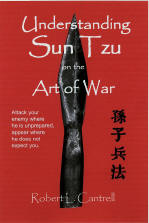
Strategies of Elimination
Cards: Chapter & Verse
Ace of Spades: I – 1-2, I – 15-16; II – 16, III – 7-9; III – 17, IV – 11, IV – 14, V – 13, VI – 15, VIII – 11, VIII – 9, X – 16-22, IX – 34, XI – 65, XI – 1, XIII – 4, XIII – 19
King of Spades: I – 16, III – 3, IV – 11, IV – 13, XIII – 4, XI – 18, XI – 60
Queen of Spades: III – 10, IV – 11, IV – 13, V – 12, IV 19-20, V – 14, V – 23, VI – 10, VI – 13-16, VI – 19, VII – 19, X – 9, X – 15
Jack of Spades: I – 16, I – 24, VI – 5, VI – 30, VII – 19, VIII – 9, XIII – 6
Ten of Spades: I – 16, VI – 2, VI – 22, XI – 66, XIII – 4
Nine of Spades: I – 23, II – 11, VII – 27, VII – 31, VIII – 10, XI – 61
Eight of Spades: I – 16, III – 3, VIII – 3, VIII – 9, XII – 15, XIII – 25
Seven of Spades: V – 5, V – 21-22, VI – 8, VI – 13-14, VI – 16-18, VI – 28
Six of Spades: I – 16-17, IV – 1-2, VI – 12, VII – 31, XI – 37, XIII – 6-9
Five of Spades: I – 16, III – 11; VII – 1, VII – 27, VIII – 10, VIII – 12,
Four of Spades: I – 16, III – 2, III – 6, XI – 54
Three of Spades: VI – 12; VII – 12, VII – 30, IX – 26, XI – 65, XIII – 6,
Two of Spades: I – 16-17, IV – 2
Strategies of Isolation
Cards: Chapter & Verse
Ace of Diamonds: I – 23, III – 1, III – 7-9, III – 17, IV – 14, VI – 3, VII – 32, VIII – 3, VIII – 11, XI – 15, XI – 20, XI – 54, XI – 58-59, XI – 63, XIII – 4
King of Diamonds: VIII – 9, XI – 20, XI – 23-25, XI – 28, XI – 30, XI – 38-51, XI – 66
Queen of Diamonds: I – 16, II – 11, II – 13-14, VI – 10-11, VI – 15, VI – 30, VIII – 9, XII – 1
Jack of Diamonds: VI – 5, VI – 11, VII – 19, XI – 18, XI – 66, XI – 68,
Ten of Diamonds: I – 18-19, VI – 7-8, VII – 31,
Nine of Diamonds: V – 5, V – 11, VI – 9
Eight of Diamonds: IV – 11, V – 19-20, VI – 5, VI – 11, VI – 30, X – 7, X – 10, IX – 16, XI – 68, X – 11
Seven of Diamonds: V – 19-20, VII – 27, VII – 29, VII 35-36, IX – 16,
Six of Diamonds: I – 20, V – 19-20, VII – 34
Five of Diamonds: VIII – 10, IX – 16, IX – 38, XI – 18
Four of Diamonds: VII – 12, XI – 67
Three of Diamonds: X – 5, XI – 20, XI – 23-25, XI – 28, XI – 38-51, XI – 58-59
Two of Diamonds: I – 16-17, VIII – 10, VII – 31,
Preparation of the Battlefield
Cards: Chapter & Verse
Ace of Clubs: I – 15-16, II – 17-18, III – 1-2, III – 7-9, III – 17, IV – 14, VI – 16, VII – 20, VIII – 3, IX – 43, XI – 52, XI – 67, XIII – 4, XIII – 6, XIII – 14, XIII – 21, XIII – 25
King of Clubs: I – 16, VI – 1, VI – 5, VI – 7, VII – 31, X – 8, X – 10
Queen of Clubs: II – 6; V – 6, V – 16, VI – 10, VII – 19, XI – 19, XI – 22
Jack of Clubs: I – 12-14
Ten of Clubs: III – 17(4), VI – 1-3, VI – 5, XI - 68, VI – 11; VII – 30-32, X – 19, XI – 66, XI – 18
Nine of Clubs: I – 16-17, III – 12, IV – 2, VI – 4, VII – 30-31, IX – 33, IX – 35-36
Eight of Clubs: III – 12; VI – 8-9, VI – 16, VI – 20, VI – 25, VII – 19, XIII – 23
Seven of Clubs: I – 16, VII – 12, VIII – 9, IV – 13, XI – 55
Six of Clubs: I – 19, I – 24, III – 12, V – 11, V – 16, VI – 12, VI – 16-17, VI – 20, VII – 19,VII – 27, XI – 19
Five of Clubs: I – 19, III – 9, VI – 12;
Four of Clubs: VII – 12, VIII – 3, IX – 26, XIII – 4
Three of Clubs: III – 12, VI – 22, VII – 20, VII – 30, VIII – 10, XIII – 11-12, XIII – 21, XIII – 23
Two of Clubs: I – 6, II – 2-4, VII – 32, XI – 68
Preparation of Self
Cards: Chapter & Verse
Ace of Hearts: III – 7-9, III – 17, IV – 1, IV – 3-4, IV – 14, VI – 8-9, VII – 31, VIII – 11, XIII – 4
King of Hearts: VI – 9, VI – 22, VI – 25, VII – 19, VII – 30, XI – 67, XIII – 6, XIII – 13
Queen of Hearts: I – 18-19, V – 17-19, VI – 8, VIII – 9
Jack of Hearts: I – 16-17, IV – 2, VI – 30
Ten of Hearts: VI – 13, VI – 9; VI – 22, VII – 12, VII – 19, VII – 30, IX – 26, XI – 67-68, XIII – 6, XIII – 13
Nine of Hearts: XI – 22, VII – 32,
Eight of Hearts: VI – 13, VI – 22-23
Seven of Hearts: XI – 28, XI – 32
Six of Hearts: VI – 9, VI – 25
Five of Hearts: I – 22, XI – 68
Four of Hearts: VI – 12, IX – 20
Three of Hearts: VII – 12, IX – 26, XIII – 6
Two of Hearts: I – 6, I – 16, I – 21, VII – 9, VII – 32, VIII – 3, XI – 68
Wild Card Strategies
Cards: Chapter & Verse
Black Joker: VI – 12, VII – 36, VIII – 3, VIII – 9, IX – 26
Red Joker: VI – 12, VIII – 9, XI – 28, XI – 40
Home |Description |FAQs |Core Value |Purchase |Companion Book |Project History |Seminars |Leadership Styles Copyright © 2004 Center For Advantage – All Rights Reserved